The Hidden Financial Cost of Untracked Claims
Insured AI Team
.png)
Most property teams treat claims as an operational problem: something for the property manager or risk team to chase down after an incident, entirely separate from the finance function. That framing translates into higher premiums. Claims aren't just an operations line item - they're a direct input into what you pay for insurance, and when they're untracked or poorly managed, they quietly inflate premiums for years after the incident is forgotten.
The piece that gets the least attention is the accrual side: connecting open claims to your financials in real time. Most portfolios simply don't do it, and the gap shows up at renewal as a number nobody can fully explain.
Claims Are a Pricing Input, Not Just a Paperwork Trail
Every claim you file becomes part of your loss history, and loss history is one of the primary things underwriters price against. A messy, incomplete, or slow-moving claims file doesn't just cost you in claim payout - it distorts the data your carrier uses to set your rate.
This shows up most visibly in experience modification: a multiplier applied to premium based on how your loss history compares to industry peers. A rating above 1.0 means worse-than-average losses and higher premiums; a rating below 1.0 means the opposite. The frequency and severity of claims drive that number directly, and a poorly tracked claim - one that stays open longer than it should, gets reserved incorrectly, or never gets closed out properly - inflates both.
Reserves matter here because the reserve amount - not the eventual settlement - is what typically shows up as "incurred" loss on the loss run underwriters review. Set a reserve too high relative to the actual exposure, and you're padding your loss history with a number bigger than the real liability. Set it too low, and the claim later "develops" upward as it's revised toward the true cost, which can look to an underwriter like your losses are getting worse over time rather than simply catching up to reality. Either error distorts the picture carriers use to price you, independent of what the claim actually ends up costing.
The problem compounds because loss runs (the claim history reports carriers use at renewal) are only as good as the underlying data. If your claims are scattered across adjuster emails, spreadsheets, and property manager inboxes, your loss run at renewal time is incomplete or stale - and underwriters price conservatively when they can't verify the full picture.
The Accrual Gap: Where Claims and Finance Stop Talking to Each Other
Here's the part that gets almost no attention: every open claim is a financial liability sitting on your books, whether you're tracking it that way or not.
Insurers reserve for this formally - setting aside IBNR (incurred but not reported) and RBNS (reported but not settled) reserves specifically because claims take time to develop, and unreserved losses distort an insurer's financial picture. Property owners and operators rarely apply the same discipline internally. An open claim with an estimated $150,000 exposure often isn't reflected anywhere in a property's budget, a portfolio's financial reporting, or a capital reserve calculation - it just sits in a claims tracker, disconnected from the P&L, until it settles and the number shows up as a surprise.
That disconnect has real consequences. Finance teams underestimate exposure at the property and portfolio level. Reserve studies and CapEx planning don't account for claim-driven liabilities in progress. And at renewal, nobody can quickly answer a basic question a broker or underwriter will ask: what's your total open claim exposure across the portfolio, right now, in dollars?
If claims data lived alongside financial data - accrued, categorized, and updated as claims develop - that question would have an instant answer. For most portfolios, it doesn't, and building that answer manually before every renewal is exactly the kind of manual effort that erodes negotiating leverage.
What Untracked Claims Actually Cost You
The financial damage from mismanaged claims tends to show up in a few consistent ways:
Delayed reporting inflates severity. Claims reported late are claims that had more time to get worse before anyone intervened - a small water leak becomes a mold remediation, a minor slip-and-fall becomes a larger liability claim because documentation wasn't captured immediately.
Stale reserves distort your real exposure. If nobody is updating claim reserves as new information comes in, your internal view of financial exposure is wrong - usually understated, which means budget and reserve decisions are being made on bad numbers.
Closed-but-unreconciled claims skew your loss run. A claim that's functionally resolved but not formally closed in every system it touches keeps showing up as open exposure to underwriters, which can hold your experience rating artificially high.
No portfolio-level visibility means no negotiating position. Without a consolidated, current view of claims and their financial status, you're negotiating renewal from a position of uncertainty rather than data.
Closing the Gap
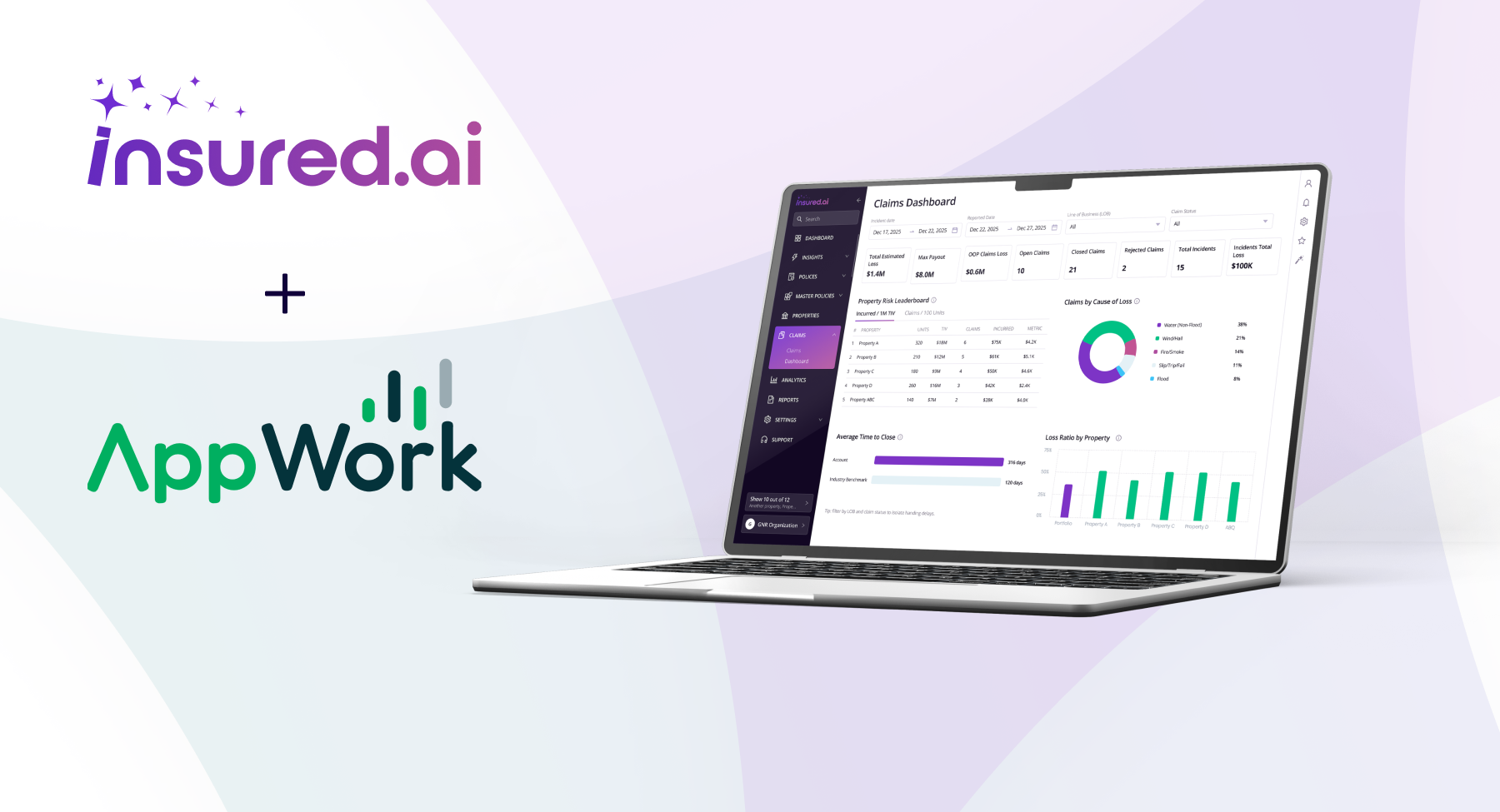
This is precisely the kind of data fragmentation Insured.ai's recent partnership with AppWork was built to address. By syncing incident and claims data automatically from AppWork into Insured.ai, multifamily teams get a single source of truth for every claim - progress, documents, adjuster communications, and financial status in one place, rather than scattered across systems and inboxes.
That's the direction claims management needs to move: not just faster claim resolution, but claims data that connects directly to the financial picture - so open exposure, reserve accuracy, and loss history are visible in real time, not reconstructed manually every renewal cycle.
The Bottom Line
Claims management isn't just an operational function - it's a financial one. Every untracked claim, every stale reserve, every incomplete loss run is quietly working against you at renewal. Connecting claims data to your financials, in real time, is one of the highest-leverage and most underserved fixes available to property teams looking to control premium costs.